

Progress in fitness shouldn’t feel like guesswork—yet for many, it does. Without objective data, you’re training in the dark, repeating reps and sets without knowing whether you’re truly improving or just maintaining. This guide changes that. Instead of relying on effort alone, you’ll learn how to use clear strength performance standards to measure where you are and define where you’re going. We’ll show you how to test your baseline, set meaningful targets across core fitness pillars, and translate those numbers into smarter, purpose-driven training. The result? Every workout aligned with measurable progress, not hope.
Step 1: Quantifying Your Baseline Across Core Fitness Pillars
Additionally, understanding strength standards not only helps identify what separates pros from amateurs but also highlights the importance of recovery strategies, such as Using HRV to Fine-Tune Recovery Decisions for optimal performance.
You cannot build a roadmap without a starting pin on the map. Baseline testing gives you objective data—the measurable facts about your current capacity—so your training stops being guesswork (and ego lifting).
Some argue testing is unnecessary. “Just train hard and you’ll improve.” That sounds motivating, but it ignores adaptation science. Without numbers, you can’t apply progressive overload—the gradual increase of stress that drives growth. In my view, skipping baselines is like investing without checking your bank balance.
• BASELINE FIRST
• Measurable Progress
• Intelligent Programming
Pillar 1 – Maximal Strength
This is your peak force output. Establish a safe 1RM (one-rep max) or a calculated 3–5RM in compound lifts like the back squat, deadlift, and overhead press. Use proper warm-ups and incremental jumps. Compare results to strength performance standards to contextualize where you stand. Speculation: as wearable velocity trackers become mainstream, 1RM testing may shift toward bar-speed predictions instead of true max attempts.
Pillar 2 – Muscular Endurance
Endurance measures sustained contractions over time. Test max unbroken pull-ups, push-ups in two minutes, or a timed plank. Think of it as your engine’s stamina setting (Captain America mode, but earned).
Pillar 3 – Anaerobic Power & Capacity
Explosive output and short-burst resilience. Use a vertical jump, 300-yard shuttle, or 30-second max-calorie assault bike sprint.
Pillar 4 – Aerobic Capacity (VO2 Max Proxy)
Assess cardiovascular efficiency with a 1.5-mile run or the Cooper Test. Pro tip: retest every 8–12 weeks under identical conditions for clean data.
Step 2: From Raw Data to Meaningful Benchmarks
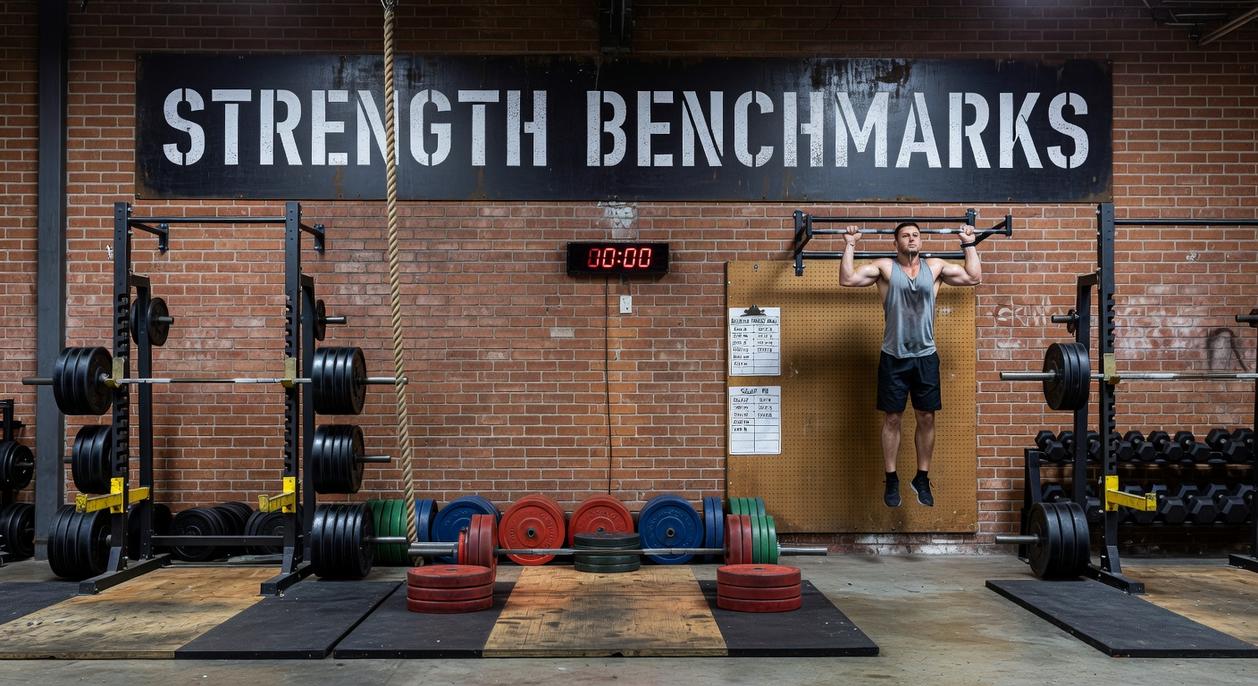
First, let’s clear up the language. A baseline is where you are right now—your current 1RM, mile time, body fat percentage. A benchmark is the target you’re chasing. Think of it as your performance GPS: one tells you your location; the other sets the destination.
Too many people stop at collecting data. They test their lifts, log their runs, maybe even screenshot their smartwatch stats (we’ve all done it). But without benchmarks, raw data is just trivia.
Using Performance Tiers
Strength standards help translate numbers into meaning. For example:
- Novice: Consistent form, building base strength
- Intermediate: Solid progression, approaching bodyweight multipliers
- Advanced: Strong relative strength and technical mastery
- Elite: Rare performance, years of structured training
For deadlifts, standards often reference Deadlift at 1.5x, 2x, 2.5x bodyweight as markers separating intermediate, advanced, and elite lifters (NSCA performance guidelines support relative strength scaling).
Now, some argue that tiers create ego-driven training. I disagree. When used properly, they create clarity—not comparison. The problem isn’t standards; it’s attaching your identity to them.
Goal-Specific Benchmarking
Here’s where nuance matters. A marathoner doesn’t need a 405 lb squat. Their benchmark might be a sub-90-minute half marathon. A tactical athlete, however, may prioritize a strict 50 lb weighted pull-up. Different goals, different metrics.
The SMART Framework for Fitness
Every benchmark should be:
- Specific: Increase deadlift 1RM
- Measurable: By 20 lbs
- Achievable: Based on current baseline
- Relevant: Supports primary goal
- Time-bound: Within 12 weeks
Personally, I believe benchmarks should feel slightly uncomfortable—but realistic. If it doesn’t stretch you, it won’t change you (Rocky didn’t train for “pretty good”).
Pro tip: Reassess your baseline every 8–12 weeks. Progress without recalibration is just guesswork.
Step 3: Translating Benchmarks into Actionable Training Protocols
Benchmarks without action are just trivia. The real win? Turning numbers into a plan that drives measurable progress. That’s where the payoff lives.
Addressing a Strength Deficit
If your 1RM lags behind your endurance metrics, your body isn’t producing enough maximal force. The solution is simple—but not easy. Prioritize progressive overload (gradually increasing weight over time) in the 3–5 rep range on compound lifts like squats, presses, and deadlifts. This rep range maximizes neural adaptation and raw strength gains (NSCA guidelines). The benefit: heavier lifts, denser muscle, and a higher performance ceiling across all training modalities.
Closing an Endurance Gap
Crushing a 1RM but failing a 2-minute push-up test? That’s a work-capacity issue. Layer in metabolic conditioning, high-rep accessory work, and EMOMs (Every Minute on the Minute). These protocols improve muscular endurance and cardiovascular efficiency. The upside: better recovery between sets and sustained output when it counts (think fourth-quarter energy, not first-scene superhero burnout).
Building Explosive Power
If your vertical jump is stagnant, your rate of force development is undertrained. Add dedicated plyometric days—box jumps, broad jumps, kettlebell swings. Power training improves athleticism and neuromuscular efficiency.
Using strength performance standards alongside your metrics ensures adjustments are objective, not emotional.
For deeper application, explore data driven programming in competitive sports—because the real benefit is clarity, precision, and faster results.
The Feedback Loop: Re-Testing, Analyzing, and Evolving Your Goals
Fitness is less a finish line and more a GPS recalculating your route. A benchmark isn’t a trophy; it’s a mile marker. Every 8–12 weeks, re-test with intention—think of it as stepping on the scale of strength performance standards to see where you truly stand.
However, before you test, schedule a deload week. This lighter phase lets fatigue drain away so your results reflect progress, not hidden exhaustion.
Then, once targets fall, raise them. Muscles adapt like students who ace easy exams—they need harder questions. Otherwise, growth stalls and momentum fades.
Your Next Performance Breakthrough Starts Now
You’ve seen the difference: simply working out keeps you busy, but training with purpose drives elite results. Random effort creates random outcomes—and that frustration you’ve felt comes from a lack of clear, measurable targets. The solution is simple and proven: the Assess-Benchmark-Train-Retest cycle. Test where you are. Set a defined benchmark. Train with intention. Retest and level up. That’s how plateaus get crushed and real strength and performance are built.
Now it’s your move. Pick one fitness pillar, perform your baseline test this week, and set a time-bound benchmark. Stop guessing. Start measuring. Start achieving.